
Little tips · 29 October 2026
What If We Didn’t Rush to Give Children the Answer?
“Why does it keep falling?”
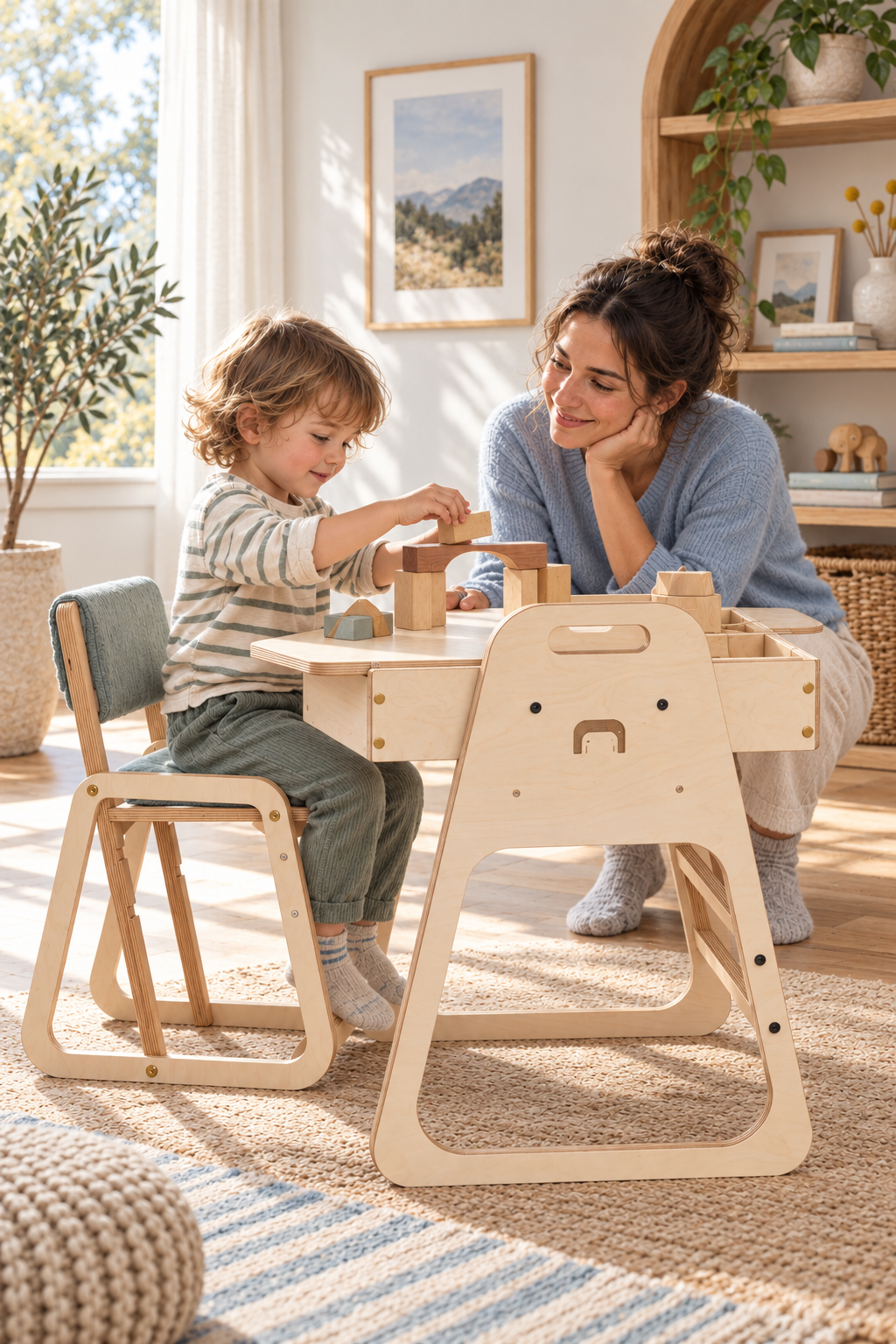
Your child is building a tower. Again. The largest block balances on top, the smallest sits underneath, and you can already see what will happen.
You could show them how to make a stronger base. But there is another possibility: pause.
“What could we change?”
A little hand reaches for a different block. The tower grows. It wobbles. Your child tries again.
An ordinary moment of play becomes an opportunity to form an idea, test it and reconsider. It also brings us surprisingly close to a way of learning associated with a philosopher who lived more than 2,000 years ago: Socrates.
What might happen if we gave children a little more room to discover an answer?
An ancient idea in everyday family life
Socrates explored ideas through conversation. He asked people to explain what they thought, consider their reasons and examine whether their ideas held together. Sometimes the conversation led to greater clarity; sometimes it revealed how much remained uncertain.
This tradition includes dialectic — examining ideas through dialogue — and the image of maieutics, or intellectual midwifery. In Plato’s Theaetetus, Socrates describes his role through the metaphor of a midwife: helping another person bring ideas into the open and examine them.
For parents of preschool children, the useful invitation is simple: take your child’s thinking seriously. Listen to their idea. Help them explore it. Leave room for it to change.
We can adapt this spirit gently, without reproducing the confrontational questioning or irony found in ancient dialogues. A young child needs to feel comfortable wondering, making mistakes and saying, “I don’t know.”
When a question becomes something children can touch
At Luula, we see sensory play as a particularly rich way to bring this questioning spirit into early childhood.
A child can investigate an idea with their hands, eyes, ears and movement, even when they do not yet have the words to explain it.
Imagine two little sandcastles. One crumbles as soon as the mould is lifted. The other holds its shape.
“What do you notice?”
Your child touches the sand.
“This one’s wet.”
“What could we try with the dry sand?”
They add a little water, mix and press. Then they lift the mould again.
Here, a question becomes an experiment. The materials give the child something to observe, compare and think about. Their next idea grows out of what actually happened.
Sensory play and Socratic dialogue are distinct approaches, but we believe they complement each other beautifully: conversation makes room for an idea, and hands-on exploration gives children a way to investigate it.
A few questions can open a whole afternoon
You do not need to prepare a lesson. Start with something your child has already noticed.
While drawing:
“What happens when these two colours meet?”
While building:
“Which part could we change to help it stand?”
While exploring shadows:
“How could we make your hand’s shadow bigger?”
While reading together:
“What makes you think the character feels lonely?”
While solving a disagreement:
“You both want the same toy. What could we try?”
These questions invite children to look closely, share their reasoning and explore possibilities. Open questions also play an important role in early childhood STEAM learning, where observation and investigation help children develop their ideas.
Ask one question, then make space. Your child may answer with a sentence, a gesture, a drawing or another attempt.
Sometimes the most useful thing you can say is simply: “Show me.”
Which familiar approaches share these ideas?
You may recognise this respect for children’s thinking in several approaches used today. They have different histories and practices; the connections below are shared principles, rather than claims that they all come directly from Socrates.
Montessori: sensory materials invite children to notice differences in qualities such as size, shape and colour. The connection is particularly clear when children compare, handle and distinguish things for themselves. Montessori also includes carefully structured demonstrations and direct teaching.
Reggio Emilia: children are understood as capable participants in making meaning. Their ideas can take shape through drawing, movement, construction, conversation and many other forms of expression — often described as their “hundred languages.” This offers a strong connection to exploration that moves between thought, materials and dialogue.
Inquiry-based learning and early years STEAM: children investigate questions, make predictions and look at what happens. A collapsing bridge or a changing shadow can become the beginning of an investigation.
Play-based learning, especially guided play: the adult thoughtfully prepares an environment and offers a timely question or suggestion, while children retain an active role in exploring. This gives parents a practical way to support learning without taking over the play.
Across these connections, we find an idea that matters deeply to us: children have something valuable to contribute to their own learning.
Knowing when to ask — and when to answer
There is no need to turn every moment into a question.
If your child asks what an unfamiliar word means, explain it. If they need help, offer it. When they are upset, begin with comfort. And when they are absorbed in play, let them stay there.
Questions work best when they grow from shared interest. A string of “Why?” questions can quickly feel like a test.
You can also share your own thinking:
“I thought that piece would stay in place. Now I’m wondering whether it needs more support.”
This lets your child see that adults reconsider ideas too.
And when a child’s explanation is mistaken, you can respond warmly while helping them look again: “You think all big things sink. Shall we see what this big wooden block does?”
Children do not need to discover every fact alone. They need both useful guidance and opportunities to think.
A small invitation for today
Place a few familiar building pieces on a comfortable play surface. Add a toy animal and offer a small challenge:
“Could we make somewhere for this animal to shelter?”
Let your child decide where to begin.
If the roof falls, pause before fixing it. If the animal does not fit, leave a moment for your child to notice. When they look for your help, explore the problem together.
A sketch, a new arrangement or another material might become their next idea. The activity can last five minutes or grow into a whole imagined world.
At Luula, this is how we imagine a place for learning: somewhere children can move between making, wondering, talking and trying again. A drawing surface, a tray of materials or a little building space can all hold the beginning of a question.
And perhaps the most meaningful part is being there together — paying attention to something neither of you needs to rush.
What might your child discover if their next question became something you explored together?